

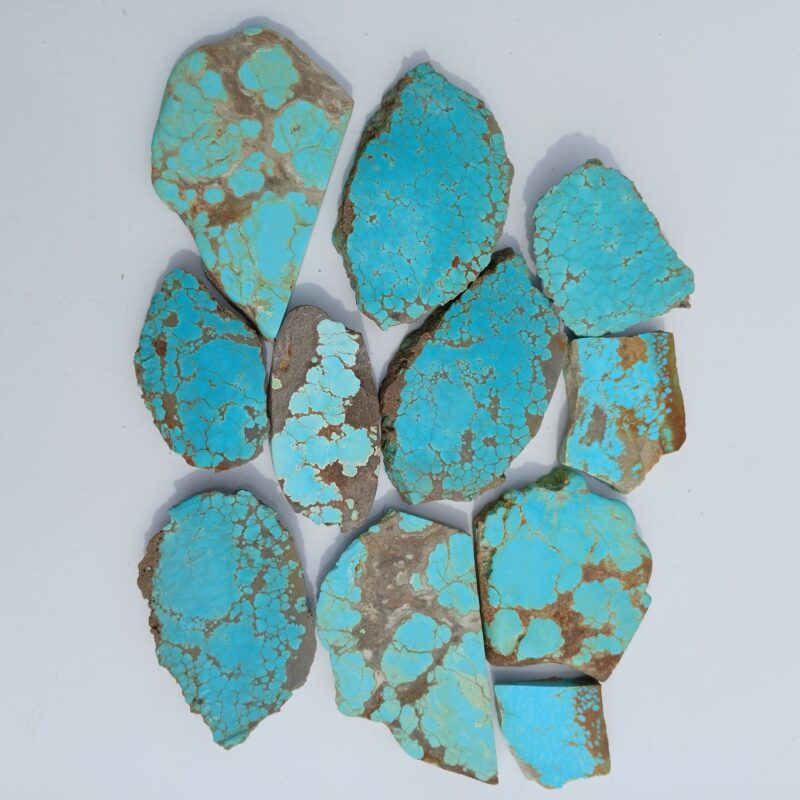
#8 Mine Turquoise
The mineral deposits, which initially comprised both turquoise and copper, were subsequently officially designated as #8 Mine Turquoise and were first discovered in 1925, approximately thirty miles north of Carlin, Nevada. With mining operations commencing in 1929, #8 Mine Turquoise quickly became one of the most recognizable and prized varieties of turquoise ever discovered. This distinctive turquoise is renowned for its exceptionally vibrant blue hue and a unique, intricate spider web matrix displaying a spectrum of colors ranging from rich browns to deep blacks. These defining characteristics, particularly the striking spiderweb pattern, have earned #8 Mine Turquoise recognition as one of the finest examples of gold-webbed turquoise. The stone’s exceptional visual appeal, historical significance, and rarity have contributed to its enduring status as a highly coveted and valuable gem.
Just When Things Were Looking Bad
By 1950, the turquoise claim at the #8 Mine seemed depleted, with the extracted stones generally considered fair to good quality. However, a change was imminent. The mine owner, seeking copper, employed a bulldozer. An excavation, approximately eight feet deep and eighty feet long, yielded an astonishing discovery: some of the finest spiderweb turquoise ever found in Nevada. This find produced over 1,600 pounds of high-quality turquoise, revitalizing the mine’s reputation.
Record Sized Turquoise Nuggets
Throughout its operational history, the #8 Mine Turquoise was frequently unearthed in the form of exceptionally large nuggets, demonstrating the remarkable abundance and character of the deposits. Among these noteworthy discoveries, one specimen, recovered on June 23, 1954, stands out as a true testament to the mine’s potential. This particular nugget, even after undergoing careful cleaning and polishing to reveal its natural beauty, registered an impressive weight of 150 pounds, a figure that underscores the substantial size of the turquoise found in this location. The physical dimensions of this remarkable find were equally astounding, measuring an impressive 33 inches in length, 18.5 inches in width, and 7 inches in thickness. These measurements not only highlight the exceptional size of this particular turquoise nugget but also serve as a vivid illustration of the extraordinary quality and scale of the turquoise deposits that once thrived at this historically significant mine.
The Discovery of Gold Marked the End for #8 Mine Turquoise
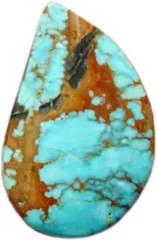
Cabochon made by the author using #8 Mine Turquoise
The cessation of turquoise extraction at the #8 Mine in 1976 was a direct result of the Newton Gold Company’s land acquisition, following a substantial gold discovery. The subsequent, intensive gold mining operations have led to the complete destruction of the former turquoise-rich area. The site where these deposits were once abundant has been irreversibly altered, and the #8 Mine has been entirely excavated, effectively disappearing due to the surrounding gold mining activities.
Highly Valued Turquoise
The currently available #8 Mine Turquoise originates from stones meticulously collected and preserved from the mine prior to its cessation of operations in 1976. The sustained high valuation of this turquoise is attributed to its remarkable aesthetic qualities, in conjunction with its current rarity. Consequently, expertly fabricated cabochons utilizing #8 Mine Turquoise can realize market prices of up to $80 per carat.
#8 Mine Chalk Turquoise
A substantial portion of the currently available #8 Mine turquoise, aligning with current market trends, is presented as stabilized chalk turquoise. Chalk turquoise, naturally too soft for conventional jewelry applications, is strengthened through a stabilization process. This process not only ensures consistent hardness, crucial for the durability of crafted pieces, but can also subtly enhance the natural vibrancy of the stone’s color.
It is important to note that “stabilized” does not equate to “dyed.” While stabilization focuses on improving physical properties, dyes are sometimes used to deepen the color palette. However, dyed turquoise typically has a lower market value than naturally stabilized or natural, untreated turquoise. Although stabilization reduces the intrinsic value of the turquoise, it generally makes the stone more practical for jewelry designs.