

Dream List
If you are a lapidary or rockhound, you likely maintain a list of rocks and minerals that you aspire to acquire. This is no ordinary list, but rather your dream list, comprising the rocks and minerals that, if you can locate and afford them, you would seize the opportunity to purchase. This list typically evolves as you gain experience or expand your collection.
Colors & Patterns
As a lapidary, I possess a distinct perspective on gemstones, differing from that of a mineral collector. Lapidaries typically evaluate gemstones based on their potential aesthetic appeal following polishing.
When seeking the ideal gemstone to add to my collection, my primary consideration is the presence of patterns and color. Given that I primarily create cabochons from the rough I collect, I search for patterns of relatively small scale, ensuring they remain visible after the cabochon is cut. Color, pattern, potential chatoyance, orbs, plumes, and other distinctive features are all factors I consider. Ultimately, I seek rough that exhibits exceptional characteristics and commands attention.
Quality
Next, evaluate the material’s quality. My yard features hundreds of rocks with a pleasing appearance, but they fall short of my quality standards. To be deemed suitable lapidary rough, the material must be capable of taking a high polish and possess sufficient durability for use in jewelry or other intended purposes.
For mineral collectors, the criteria differ, focusing instead on the mineral’s formation, whether it is in matrix, and its rarity in that matrix. Additionally, collectors assess the mineral’s color and clarity.
Securing high-quality rocks and minerals online can be challenging. It is essential to examine customer feedback and ratings for the seller, as well as the quality of their other offerings. If the majority of their material appears subpar, it is likely that the specific item of interest will not meet expectations.
Most importantly, educate yourself and gain a thorough understanding of what high-quality rocks and minerals look like. Often, when searching online for something I truly appreciate, I include the term “museum quality” in my query. Adding “museum quality” to the name of the rock or mineral I am seeking typically often yields spectacular results, although one should not expect them to be inexpensive.
Rarity
When seeking the ultimate rock collection, consider the rarity of the rock or mineral. This is where the law of supply and demand applies. If the rock or mineral is extremely rare and highly sought after, anticipate paying premium prices for it. On the other hand, rarity alone does not necessarily make a specimen desirable for your collection.
On the other hand, just because something is rare, doesn’t mean that it is something that you want to necessarily have in your collection. Do not forget to consider the quality of the material you are contemplating purchasing.
My Dream Lapidary Rock Collection
At the risk of creating competition for myself, here are the rocks and minerals I would desire for my ideal rock collection:
Trent Agate
Trent agate is another highly elusive agate variety. This Sagenite Agate features black Stibnite crystals and the reddish hue of Realgar crystals. This distinctive agate was highly prized by lapidaries, but unfortunately, its supply was extremely limited and only available for a brief period.
Royal Aztec Lace Agate
This exceptional agate originates from Durango, Mexico and is no longer available in substantial quantities. It boasts a striking purple-blue to purple hue with intricate lacy fortification patterns.
Clay Canyon Variscite
If you appreciate the green color of Variscite, you will likely admire this exceptional material. Clay Canyon Variscite originated from the Little Green Monster Variscite Mine near Fairfield, Utah. This variety of Variscite exhibits a distinct appearance compared to other forms of Variscite, often featuring lines of yellow Crandallite traversing the green Variscite. Should you encounter a museum-grade slab of Clay Canyon Variscite, expect the price to exceed $1000.

Bloody Basin Plume Agate
Most of the agate originating from Bloody Basin, Arizona, is moss agate; however, in recent years, a remarkable variety of plume agate has been discovered at this location. Bloody Basin Plume Agate exhibits a striking yellow and orange color, with occasional green hues. Typically, moss agate forms at the base of the plumes.
Wingate Plume Agate (Death Valley Plume Agate)
What a remarkable plume agate specimen. Unfortunately, the area where this agate is located is now off limits and cannot be collected. It features fantastic yellow and orange plumes, yielding a truly spectacular appearance.
Paisley Plume Agate
Another agate now found exclusively in collections, this exquisite pink to purple plume agate boasts a fine and complex fortification structure. Paisley Plume Agate originates from Blythe, California.
Sheep Creek Plume Agate
This exceptional plume agate was extracted from private property in Oregon, an area that has been inaccessible for collecting purposes for many years. The agate features attractive white and tan plumes, accompanied by black dendrites.
Indian Blanket Jasper
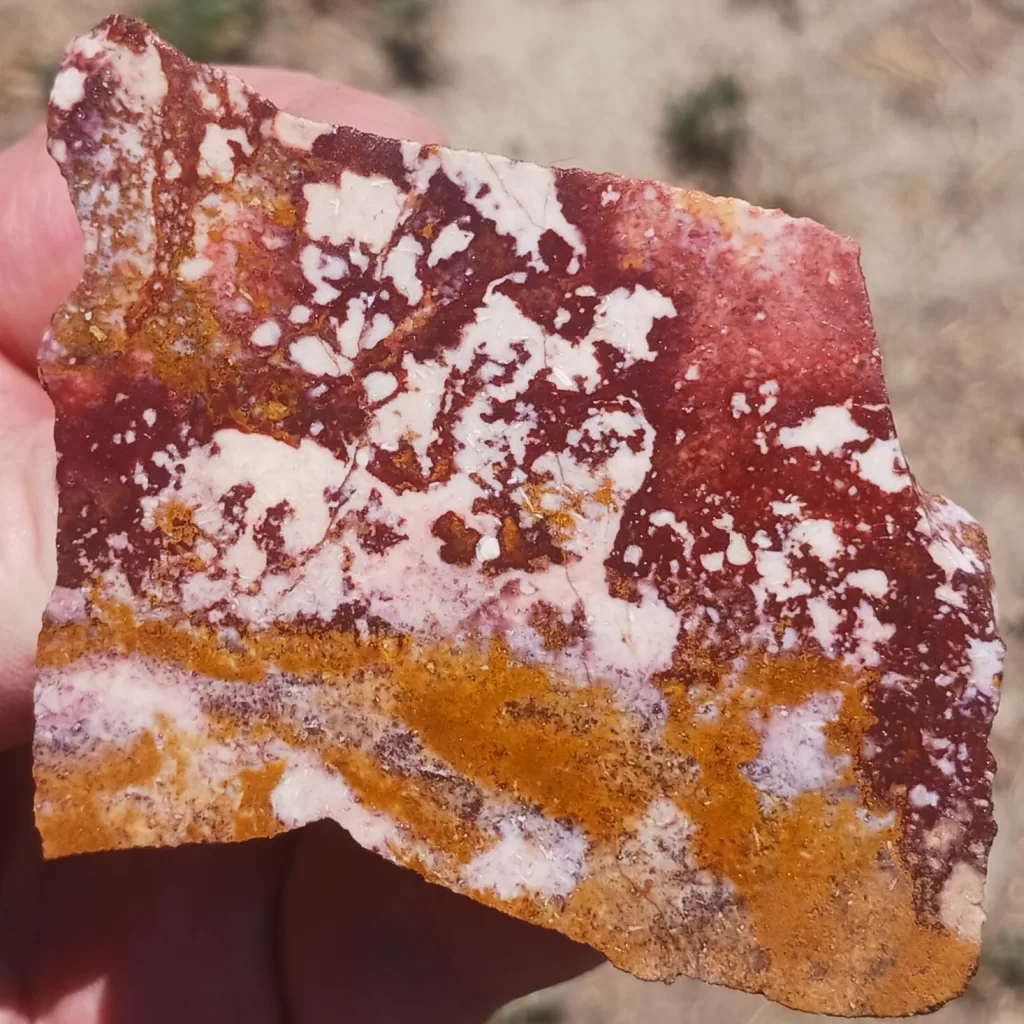
I highly appreciate this jasper, as every slab and cabochon exhibits unique characteristics. It predominantly features warm, earthy tones, including brown, orange, red, purple, yellow, pink, and white.
High-quality Indian Blanket Jasper is truly exceptional and takes a superior polish. Notably, much of the highest-quality Indian Blanket Jasper resembles opalite more closely than jasper. When cutting cabochons from this material, it is essential to maintain a cool temperature during the polishing process to prevent breakage. This particular jasper is no longer available.
Brazilian Green Cat’s Eye Opal
Conducting an internet search for “green cat’s eye opal” yields numerous results for imitation gemstones composed of glass or fiber optic material. However, searching for “Brazilian green cat’s eye opal” may lead to the discovery of a rare and exceptional gemstone. This extraordinary gemstone features a highly chatoyant layer of green to golden yellow opalite material sandwiched between two layers of green serpentine.
This unique material is unparalleled and lends itself to the creation of truly stunning cabochons. Discovered in 1991 in the Brazilian province of Bahia, this material is a relatively recent discovery that is seldom encountered in the market today.

Oregonite
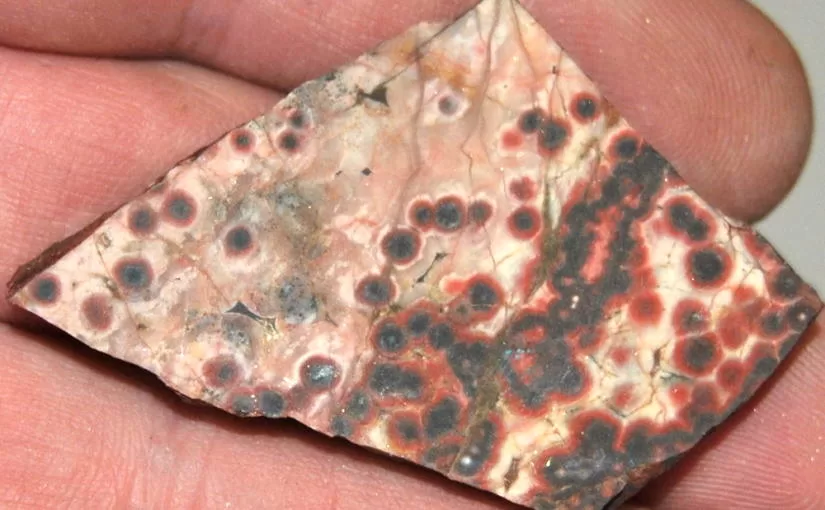
Oregonite originates from Josephine County, Oregon. It exhibits a similar appearance to Kinradite found in California, but features a distinctive yellowish-white to white outer fringe surrounding the spherulite formations. This exceptional reddish-brown and white jasper-like material was briefly available before becoming inaccessible.
Newly Discovered Rocks and Minerals
Every year, new rocks and minerals are showcased at local rock and gem shows. Often, the first public appearance of a newly discovered rock or mineral occurs at The POW WOW, as well as at several other prominent rock and mineral shows in Quartzsite, Arizona.
Collecting newly discovered rocks and minerals is an excellent way to initiate a remarkable new collection, particularly for those on a budget. These newly introduced rocks and minerals often lack a strong following, resulting in lower demand and subsequently lower prices.
I have frequently purchased rough specimens to gauge my interest, only to find that their value has increased significantly the following year. In hindsight, I regret not purchasing more Ocean Jasper when it was available for $4 per pound.