


A huge chunk of turquoise from Mineral Park Mine in Kingman AZ
Source: Aramgutang-public domain-via Wikipedia
Official Gemstone of Arizona
Turquoise has been designated as Arizona’s official state gemstone since 1974, a recognition that underscores its profound cultural and historical importance. Archaeological evidence indicates that Native Americans residing in the Southwestern United States utilized this remarkable gemstone long before the Common Era, demonstrating its sustained appeal and utility. Although turquoise deposits exist in other western states, including California, New Mexico, Nevada, and Colorado, Arizona maintains its position as the leading producer, as evidenced by the value of its turquoise production, according to minerals.usgs.gov.
The desirability of turquoise is frequently linked to its vibrant color palette. The most valued specimens display a spectrum of hues, ranging from the tranquil clarity of a clear sky blue to the captivating “robin’s egg” shade. The Sleeping Beauty Mine in Arizona serves as an exemplary source of this exceptional color range, producing turquoise that epitomizes the gemstone’s appeal. While the flawless, brilliant blue turquoise from this mine is highly esteemed for its pristine beauty, collectors of Arizona turquoise often favor stones featuring a distinctive “spiderweb matrix,” which introduces a unique character and intricacy to these prized gems.
“Fun Fact”
Arizona officially recognizes the Bola Tie, alternatively referred to as the Bolo Tie, as its official neckwear. These items are skillfully constructed from braided cord or leather, featuring decorative metal details at their extremities. The Bola Tie is worn similarly to a conventional men’s tie; nonetheless, it incorporates a distinctive design element: the cord is secured with an ornamental clasp or slide. These clasps and slides are often made of Sterling silver and Arizona Turquoise, merging artistry with the state’s signature gemstone.
Turquoise Mountain & Birdseye Turquoise
Both Birdseye and Turquoise Mountain Turquoise come from the same mine near Kingman, Arizona about a ¼ mile from Ithaca Peak. The mine closed in the 1980s however during my recent visits to Colbaugh Processing I found the material is still available for purchase today. Birdseye Turquoise has a unique darker blue matrix surrounding the beautiful light blue turquoise. Birdseye Turquoise was offered stabilized, but natural color by Colbaugh Processing at $450.00/lb at the time this article was written.
Blue Bird Turquoise
The Blue Bird Turquoise mine, one of the most clandestine turquoise sources in Arizona, maintains an enigmatic location. While conjectures suggest it might have been a smaller operation within Cochise County or an extension of the Sleeping Beauty Mining operation, the precise site remains unknown. Currently inactive and no longer yielding turquoise, this mine was recognized for producing a robust stone characterized by diverse matrix patterns.
Note: There is another turquoise from Nevada called Little Blue Bird Turquoise that is often mistaken for Blue Bird Turquoise due to the name similarities.
Bisbee Turquoise
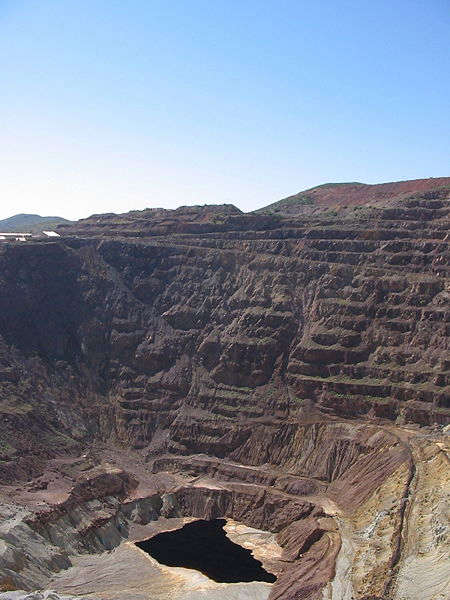
The Lavendar Pit near Bisbee, Arizona.
Cornellrockey-CC-BY-SA-2.5 via Wikimedia Commons
Bisbee Turquoise represents one of the most coveted varieties of turquoise originating from the Southwestern United States. Currently marketed under the registered trademark “Bisbee Blue,” it is characterized by its distinctive brilliant blue hue, complemented by a matrix displaying reddish-brown or chocolate tones. The unique colorations and patterns exhibited by Bisbee Turquoise are unparalleled, setting it apart from any other source globally. The predominant source of Bisbee Turquoise was the mine designated as the Lavender Pit.
The majority of turquoise recovered from the Lavender Pit was initially disposed of as waste material, predating the recognition of its aesthetic qualities. However, select quantities were extracted by miners who recognized its inherent value, referred to as “lunch-boxed.” Upon its introduction to the public, it was acknowledged as among the finest turquoise specimens ever discovered, subsequently becoming highly prized by collectors and silversmiths.
In more recent years, tourists have been granted permission to collect small quantities of turquoise from the surrounding disposal areas. This activity commonly takes place during Father’s Day weekend, when a designated portion of the dumps is exposed. For a nominal fee, a limited number of visitors are afforded the opportunity to search for turquoise and other copper minerals.
Castle Dome Turquoise
The Pinto Valley Mine, formerly designated as the Castle Dome Mine, concluded operations during the early 1970s; however, it was previously a significant turquoise producer within Arizona. The extracted turquoise frequently necessitated stabilization owing to its inferior quality. High-quality Castle Dome Turquoise is characterized by its rarity. Located approximately 30 miles from the celebrated Sleeping Beauty Mine near Globe, Arizona, Castle Dome Turquoise displays certain visual resemblances to Sleeping Beauty Turquoise, albeit with a more vivid blue coloration and the presence of matrix patterns. Upon its cessation, the mine site was reclaimed through infilling and the reintroduction of native plant life.
Morenci Turquoise
Morenci Turquoise exhibits a spectrum of blue tones and diverse matrix patterns; however, it is particularly distinguished by the presence of iron pyrite, commonly referred to as “fool’s gold.” For an appreciable duration, the rights to mine Morenci Turquoise were conveyed to private entities. Nevertheless, these leases have since terminated, and turquoise mining operations in Morenci are currently prohibited.
Kingman Turquoise
Kingman Turquoise, sourced from the Mineral Peak Mine, is highly prized worldwide. It exhibits a range of blue and green hues, with particularly sought-after specimens featuring untreated, medium to dark blue tones, occasionally including pyrite inclusions, which are highly valued by collectors. Natural, untreated Kingman Turquoise is exceptionally rare. This turquoise is marketed under the names Kingman, Ithaca Peak, and Turquoise Mountain Turquoise.
Ithaca Peak Turquoise
Historically, Ithaca Peak was esteemed for yielding some of the finest turquoise specimens within the United States. Nevertheless, the adjacent Turquoise Mountain has subsequently emerged as the predominant source of turquoise in the area. As a result, any high-quality Ithaca Peak turquoise that may become available from existing collections is anticipated to fetch a considerable price.
Sleeping Beauty Turquoise
Sleeping Beauty Turquoise, a highly prized variety favored by Zuni Pueblo silversmiths, is distinguished by its nearly matrix-free, solid, light blue coloration. The Sleeping Beauty mine, located near Globe, Arizona, has produced significant quantities of turquoise. Nevertheless, natural, untreated Sleeping Beauty Turquoise is exceptionally rare and commands a high value. Due to its lack of veining and vibrant “robin’s egg” blue hue, it is frequently replicated using reconstituted turquoise or plastic.
Use Caution When Purchasing Turquoise
Dyed Howlite & Magnesite
The history of counterfeit turquoise production encompasses numerous years, employing diverse techniques to create deceptive imitations. A prevalent method involves dyeing rocks blue to replicate the appearance of authentic turquoise. Howlite, a mineral characterized by distinctive veining patterns that closely resemble those of certain turquoise varieties, is frequently used for this purpose. Its porous nature allows for easy dye penetration, resulting in uniformly colored stones that are challenging to distinguish from genuine turquoise, even for experienced gemstone identifiers. Magnesite nodules represent another commonly utilized mineral in the fabrication of imitation turquoise; once dyed, these nodules closely resemble natural turquoise nuggets.
Reconstituted Turquoise
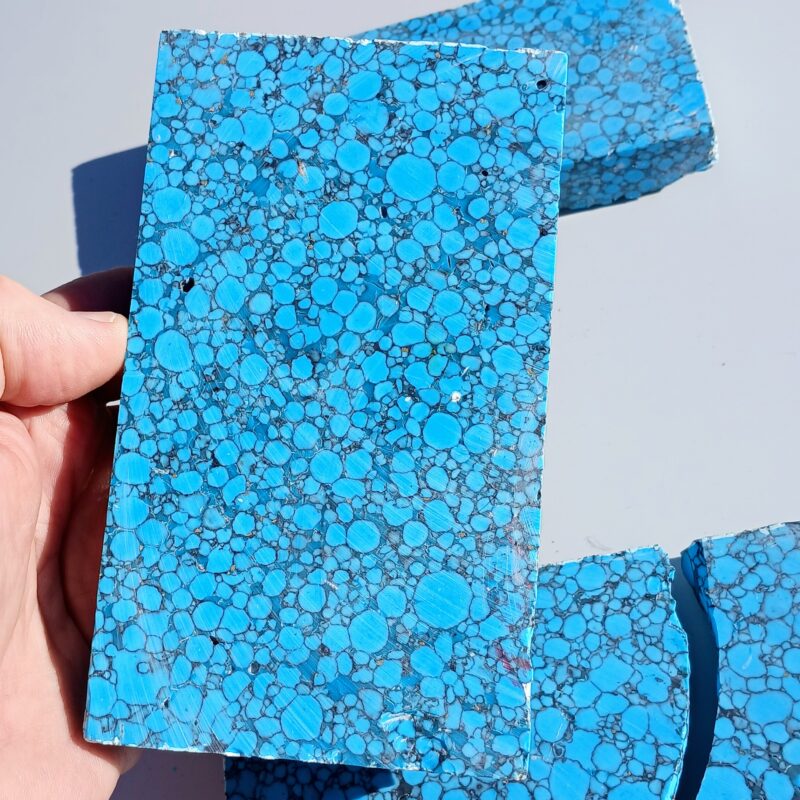
Reconstituted Turquoise
Reconstituted turquoise is a manufactured material created by combining finely ground authentic turquoise with plastic resins & dyes, designed to mimic the appearance of natural turquoise. Artificial veins may be added to enhance the resemblance. Its lower production costs and consistent appearance make it frequently used in mass-marketed jewelry. However, it is often deceptively marketed as authentic turquoise, creating issues in the marketplace. This practice misleads consumers and harms legitimate turquoise vendors. Therefore, increased consumer awareness and education regarding authentic turquoise identification are essential to combat counterfeit products and protect consumers and ethical businesses. Although reconstituted turquoise is a practical alternative for jewelry due to its resistance to oils and chemicals, it should never be misrepresented as genuine, authentic turquoise.
Imitation Turquoise
In addition to the aforementioned methods, a variety of other materials are employed in the creation of imitation turquoise. These include glass, plastic, and ceramics. More recently, polymer clay has emerged as a popular material for this purpose.
Turquoise Treatments
Stabilization
Real turquoise frequently undergoes treatments, and it is important to note that naturally untreated turquoise is considerably rarer than its processed counterparts. The most prevalent treatment employed is a process known as stabilization. A significant portion of the turquoise extracted from mines possesses an insufficient hardness level for practical application in the creation of jewelry. The stabilization process is specifically designed to enhance the structural integrity of the turquoise, rendering it robust enough to withstand the demands of cutting and incorporation into jewelry designs. Furthermore, stabilization provides a protective barrier, safeguarding the turquoise from potential damage caused by external factors such as perspiration, lotions, and various sprays that may come into contact with the gemstone during regular wear and tear as part of jewelry.
Color Enhancement
Color enhancement constitutes a specialized treatment method applied to turquoise, characterized by the intentional introduction of color within the gemstone. This procedure is frequently implemented during the stabilization and/or compression phases of turquoise processing. The primary purpose of color enhancement is dual: to augment the aesthetic qualities of turquoise of inferior initial quality or to generate color variations not found naturally within the gemstone. The artificially induced colors can manifest as subtle augmentations or striking, non-natural hues, including vibrant purples or intense greens, which are not characteristic of naturally occurring turquoise.
Wax Treatment
Turquoise wax treatment represents a frequently utilized enhancement technique specifically designed for porous turquoise. In this process, the stone undergoes treatment with substances such as paraffin, various oils, or resins. The primary objectives of this treatment are to intensify the natural color of the turquoise, significantly enhance its luster or shine, and create a protective surface barrier against the accumulation of oils and dirt. These enhancements collectively improve both the visual appeal and the long-term durability of the turquoise, making it more suitable and practical for everyday wear, particularly when incorporated into jewelry pieces. This specific treatment is frequently applied to less expensive turquoise, often sourced from China.